eBuilding:
An overview of key eBuilding features
There are certain aspects to eBuilding that
are not readily distinguishable from competitive
products by persons unfamiliar with fundamental
Internet data exchange technologies. These
features will quickly become apparent as
key advantages in the eBuilding product
design, as more and more businesses look
to conduct business and execute distributed
control strategies using the Internet.
1.
eBuilding as an Internet Appliance
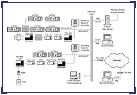
As with most new marketing terms, there
are a number of definitions of “Internet
Appliance”. We view the idea of an
Internet Appliance as a device that is easily
Internet accessible, in terms of its presentation
to a user interface or data interface. Since
an Internet connection is typically provided
by any one of a number of outside sources,
such as an ISP running DSL or a cable company
using cable modems, Teletrol chose the most
common denominator connection scheme, 10/100
Mbps Ethernet. For configuration, software
download and data access, our appliance
assumes that we have a connection to the
Internet that is Ethernet based and passes
the same protocol used for the delivery
of web pages, HTTP. Virtually every company
or home Internet connection today supports
HTTP.
Many competitive products rely on earlier
technologies that need other external equipment
to pack and unpack the data, before using
the Internet as the transportation medium.
Only locations that have this equipment
are then capable of accessing the data.
In other competitive products, protocols
essential to their device communication
require that corporate firewalls be opened
and security compromised in order to exchange
data over the Internet.
The reason many of these shortcomings exist
in competitive products is because most
of the technologies upon which they were
built were designed to operate in a single
LAN environment. While these technologies
are excellent choices for LAN-based data
exchange, they do not adequately address
the needs of an Internet-based system. |
Click
here for a larger image |
|
2.
XML and Microsoft’s .NET
Before Microsoft went public with their
.NET initiative, the eBuilding design
was already well underway with the same
technologies (XML and SOAP) that Microsoft
has featured as key to their continued
success. Teletrol selected XML as the
way to represent the state of the system,
configure the system, and deliver data
from the system to third party devices,
regardless of the operating system or
hardware platform. eBuilding can easily
deliver real-time or historical data,
energy consumption for example, to any
server that has a way to capture the
XML data, handle it and store it locally.
XML fits well with many business systems
that are already in place. There is
no need for expensive or proprietary
software for data conversion, or to
purchase a specific piece of hardware
or database software. |
SOAP extends the functionality of XML by allowing
XML formatted data to invoke a program on
a remote server, creating a true Internet-based
distributed software component system. For
example, a server that monitors and controls
demand reduction strategies for facilities
scattered throughout the United States is
located in Toronto. SOAP allows an individual
eBuilding controller to send data to the Toronto
server and ask it to review its strategy,
based on specific local conditions. The Toronto
server has access to information from all
the sites and from other related servers,
and it can make decisions according to aggregated
real-time conditions at all of the sites.
The Toronto server then delivers data to the
original eBuilding controller to invoke a
specific action algorithm, and it continues
to run with that information until it needs
to make the next adjustment. |
3.
Object Oriented Technology
“Object oriented” is a term typically
used to describe how software programs are
written, whereas an object oriented design
will deliver much more than just making programs
easier to create. For years, software engineers
wrote monolithic programs that were not inherently
reusable, because the entire project or process
was modeled as a single, large piece of code.
Internally, it may have consisted of smaller
routines, but there were no clear and enforced
divisions between the code that ran lighting
schedules, for example, and the code that
ran air handlers. Changing the code in one
routine could cause unanticipated problems
with the other.
The goals of an objected oriented design are
to effectively decouple many of the dependencies
between the different routines in the system,
and to take advantage of that decoupling so
individual physical devices can be modeled
as objects in software. Each object contains
programming detailing how it operates, and
parameters, which customize its behavior.
In HVAC, if we create a pump object, we can
encode all of the software necessary to make
the pump operate properly and access parameters
that customize its operation, such as lead/lag
sequencing, flow characteristics and the values
of its high and low limit safety shutoff points.
4.
Programming Language
Once object oriented technology is employed
to represent in software the individual elements
of any control system, HVAC or otherwise,
they are easily recognizable to the user as
the actual devices they are modeling, not
as so many lines of undocumented software.
Teletrol’s eBuilding programming language
combines an object-oriented approach very
naturally with a graphical interface, so that
each object in the physical system is represented
in the programming language as a separate
block or graphic.
A pump in the real world may have three inputs
and two outputs; the pump object on the programming
screen will likewise have three inputs and
two outputs. Connecting the software objects
together with lines mimics how they are connected
with wires or pipes in the real world facility.
Beyond that, entire groups of objects can
be combined into larger objects or systems,
making the program faster and easier to create.
An air handler and the associated VAV boxes
for the 2nd Floor can be grouped into an object
called “Floor 2”; that object can
then be duplicated over many times to create
similar objects representing Floor 3 through
Floor 10.
Beyond the simplicity and power in programming,
the object-based approach allows the operator
to replace a chiller object representing Manufacturer
1’s product with a chiller object representing
Manufacturer 2’s product. These chillers
can behave in very different ways, but if
the interfaces between the chiller objects
and the other objects in the system are consistent,
the programming changes would be minimal.
By combining this with eBuilding’s ability
to remotely and automatically load programs
to field mounted controllers, Teletrol can
develop a modeling system for energy or maintenance
monitoring that is self-updating as the intelligence
contained in each of the objects is updated.
For example, when you determine that there
is a more efficient or cost effective way
to control your chillers, eBuilding will allow
you to create that object, replace it in your
programs, then update all of the controllers
overnight, to realize savings from the new
model immediately.
While some competitors have graphical programming
languages, few have an object-oriented approach
that truly divides the programming among software
objects that represent the physical devices
in the system. This design feature is the
key to many of the planned advances in eBuilding
beyond the year 2001. |
|
|
·
Products
·
Case Studies
·
Services & Support
·
Teletrol News
·
About Teletrol
·
Contact Us
·
Home
·
If you have any questions, comments, or problems regarding this service,
please contact us at [email protected].
Copyright
©2002 Teletrol Systems Inc. All rights reserved.
Legal Disclaimer
Teletrol Systems Inc., Technology Center, 286 Commercial Street, Manchester, NH 03101
Main Number: (603) 645-6061, Fax Number: (603) 645-6174,
e-mail: [email protected]
|